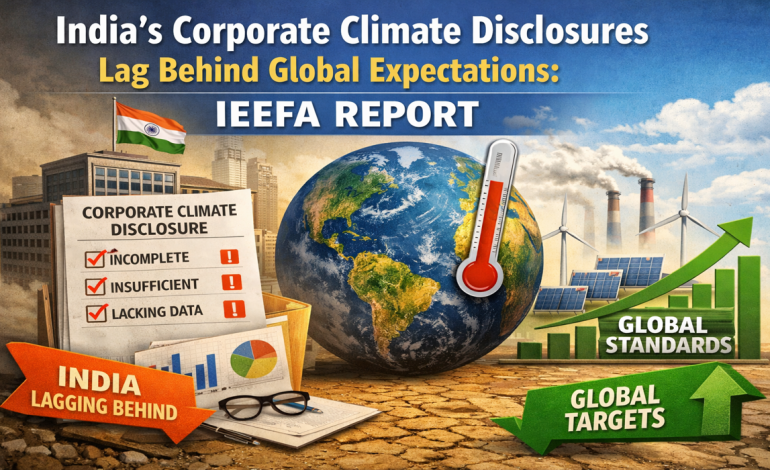

India’s corporate climate disclosure framework may not meet global investor expectations as transition planning becomes a key factor in capital allocation, according to a new assessment by the Institute for Energy Economics and Financial Analysis (IEEFA).
The analysis highlights that while India’s Business Responsibility and Sustainability Reporting (BRSR) framework takes a broader ESG approach, it falls short in providing essential details for credible climate transition planning.
BRSR vs Global Standards
IEEFA compared BRSR with the International Sustainability Standards Board (ISSB) S2 climate standards. The findings revealed that BRSR lacks several critical elements required for investors to evaluate transition risks and strategies:
-
Mandatory scenario analysis for climate risk
-
Clear links between greenhouse gas targets and transition actions
-
Climate-specific governance disclosures
-
Funding strategies for climate transition plans
By contrast, ISSB S2 offers detailed, climate-focused guidance, including scenario analysis, disclosure of transition strategies, and the expected financial impact of climate risks and opportunities.
Focus on Social Metrics Over Climate Risks
IEEFA noted that BRSR emphasizes high-level ESG indicators, particularly social metrics, while climate-related stakeholder dependencies receive limited attention. Key areas such as supply chains, customer exposure, and workforce transition risks are underrepresented.
This means that while BRSR provides stronger and measurable indicators for community engagement, it may not deliver decision-useful information for investors assessing long-term resilience and climate transition strategies.
Investor Implications
Investors increasingly demand transparent climate transition planning as part of risk assessment and capital allocation. The current gap in India’s reporting framework could lead to limited comparability with global standards and reduced confidence in corporate transition plans.
IEEFA’s analysis suggests that improving BRSR alignment with ISSB S2 standards will help Indian companies communicate climate risk exposure and transition strategies more effectively to investors.
Conclusion
As global capital increasingly focuses on sustainable investments, India’s corporates must enhance their climate disclosures to match international standards. Strengthening climate-focused governance, scenario analysis, and transition planning in BRSR is essential for fostering investor trust and long-term corporate resilience.